Types
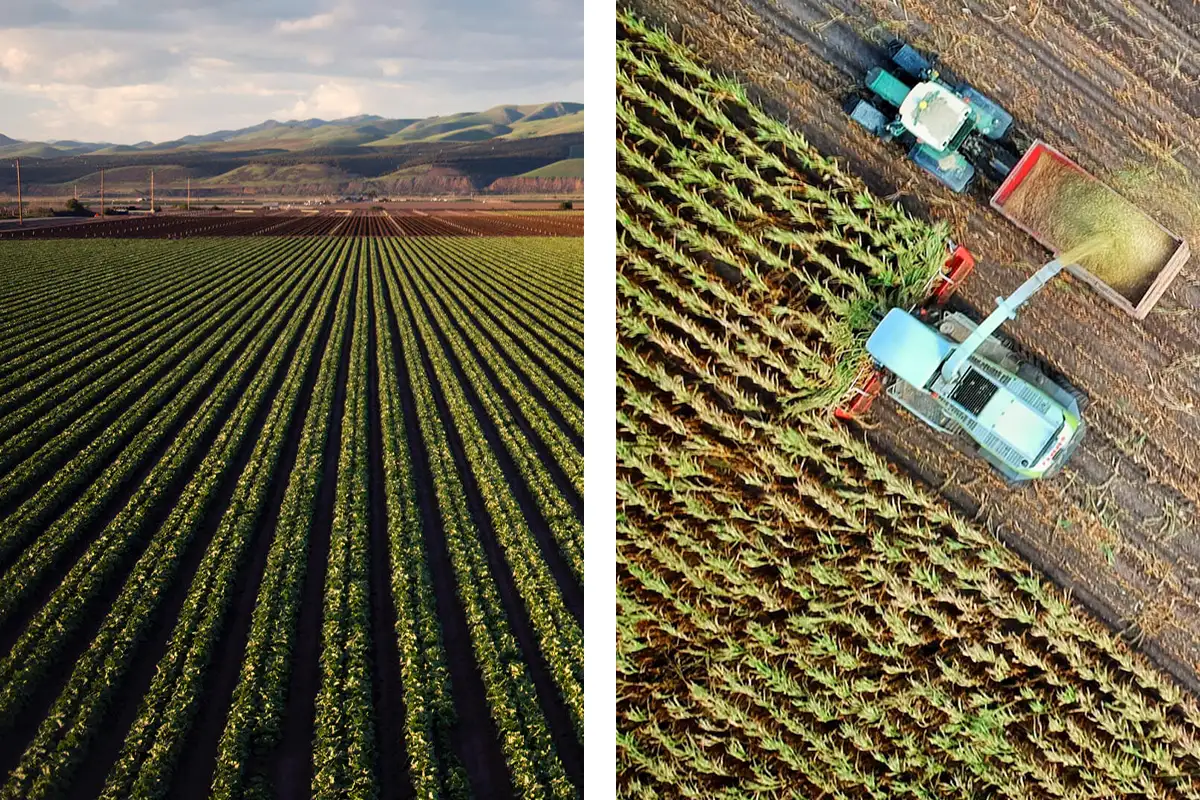
Cropland – land used to produce adapted crops for harvest and includes two subtypes: cultivated and non-cultivated. Row crops are considered cultivated, and permanent hay land is considered non-cultivated.
Grazing Land, Pasture Land – diverse types of land that produce primarily herbaceous plants that provide forage food for cattle, sheep, horses and other livestock.
Permanent Crops, Tree Crops – this land use includes trees that bear fruit or nuts as well as timberland or tree plantations that provide wood.
Vineyards – land used to produce grapes to produce wine and other grape derived spirits.
Greenhouses – structures constructed to produce certain types of produce, often including tomatoes, flowers, and other delicate crops
Cattle, Swine and Poultry Farms – Farms dedicated to the production of animal meat and products such as beef, pork, and poultry.
Dairy Farms – farms used to produce milk and other dairy products.
Approaches, Relevance
Cost – Agricultural properties require investment and costs to construct greenhouses, irrigation, and to improve the soil. This approach is particularly useful as it gives a baseline cost for an improved property. A point of reference for the value of said project can be developed by analyzing the cost of buying raw land and developing a new agricultural project.
Sales comp or market approach – this approach is useful when the comparables are similar to the subject property. A good example would be large, flat farmland with minimal improvements and similar soil characteristics. In this way, the properties would we very similar in terms of production and value.
Income capitalization – income capitalization of agricultural properties can be approached in two different ways. In one way, the prospective rent of the land can be capitalized to arrive at a value. The other method is to reconstruct the income and expenses of an agricultural project, apply operating costs, and capitalize the net income.
Both approaches are applicable, however, the primary method is preferable, as the typical rent of a property is market driven, and therefore more reliable than a specific profit and loss projection of an agricultural operation – which can be positively or negatively affected by the operator.
DCF – The cashflow method can also be utilized to evaluate the rental stream of an agricultural property or the complete operation cashflow can be projected.
Value Impacting Factors
Crop Yield – crop yield has an impact on gross income of the agricultural operation and affects value.
Crop Type – more profitable crop production is associated with higher valued property. The higher priced the crop impacts the yield of the property, and in turn the value someone would pay for it.
Soil Type, Characteristics, and Geology – the type of soil has a major impact on what types of crops it can support. The depth of the soil, the elevation, drainage, access, climate, all have impacts on what the property could be used for. Ph of the soil and if it is level impact the usability of the property for agricultural purposes.
Water Supply – often, the water supply is crucial for most agricultural properties. Wells, access to irrigation or flowing water have an impact on value.
Access – an important factor that aids in the delivery of fertilizer and seed, and, in turn the delivery of the crop to distribution facilities and the market in general.
Important Inputs
- Crop yields and crop prices
- Rent as a % of gross income (a way to verify rental rates)
- Cap rates and discount rates